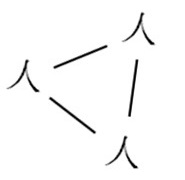
In Nexus Theory, we will use the term “society” to refer to a very expansive set of human organizational structures. Some examples include a nation, a religion, fans of a certain sports, a gang, an art ‘scene’, a family, and so on.
A “society” is a bounded group of people who have some regular form of interaction. A society is also the mental structures related to socialization that form in an individual’s brain with repeated exposure to interacting with that group. Bounds can anything that defines a group of people, so it could something like geography, or genetic similarity, or club membership, etc.
Society are made up by individuals. They reflect the drives of these individuals. A society usually tempers some of the drive satisfaction of some individuals, and in exchange they sometimes enhance other areas of drive satisfaction for that same person. (Although this is not always the case.) The extent of drive satisfaction that an individual gains from being part of their society is adjusted by their level of power and influence in that society.
Societies often promotes models of reality to their members that allow those societies to function. For example, a political society may promote the obedience to a king and instill a deep respect for authority into their members. A religious society may introduce a set of rules that must be followed in exchange for obtaining a happy afterlife. A problem that comes up is that sometimes a model of reality may be outdated but society keeps it in place as it is often integrated with the current power structures of that group.
Societies are not just influenced by individuals that are currently living. Many societies are continuations of ideas that were made by individuals in the past who helped build or contribute to that society or its model of reality.
Social Structure
The actual forma society can take is influenced by several internal and external factors.
The genetics of the members of that society, as these determine basic variation an ability levels of the people that compose that society. (For examples, Nepalis and Andean peoples have a genetic variation that allows their bodies to better function at high altitudes.). It also effects drives that are expressed and other factors as well as the internal power dynamics of that society.
The environment also sets limits to what forms a society can take. Basics resources such as water, temperature, food availability have great effects on what forms of life can take place.
Other important factors include technology/ideas/tools of a society, as well as competing societies.
All societies face these boundary conditions. The long-term change in the structure of a society is usually a response to a change in one of these boundary conditions.
Purpose of a Society
In summary, a society is just an outgrowth of desires of the individual tempered by their boundary conditions, built over time. As such, in Nexus Theory, we treat society as a tool. Something that exist for a purpose. It is not considered a holy or special object or concept that must never be changed. Instead, it should be changed regularly and appropriately in response to changes in boundary conditions in order to enhance the drive satisfaction of its members.
 Nexus Theory